Tiny Travelers: Engineering Seed Dispersal like Nature Does!
Have you ever wondered how dandelions float so effortlessly through the air, or how seeds manage to hitch rides on animals as they pass by? In my Bionic Design course, I got the chance to dive into the fascinating world of seed dispersal and transform nature’s clever strategies into a real, working mechanism. Thanks to my earlier Biomimetic Science course, I had already learned how to abstract the functional principles of biological models and that skill came in handy for this project.
Funny enough, I never planned to focus on Bionics. I sampled different electives, unsure of what direction to take. But after just one lecture in Biomimetic Science, I was hooked. I followed it up with a class in Zoological Physics, and by the next semester, I knew this was the field for me. That’s when I officially chose to dive deeper and signed up for Bionic Design and Bioinspiration.
To be honest, I’ve always had a soft spot for Biology. Back in high school, it felt like the most relatable of the natural sciences;comprehensible, yet surprisingly deep (but not in the scary, quantum physics kind of way). So when the time came to choose a project for my Bionic Design exam where we had to make a fully functioning device, I was keen. We were given a few themes to explore, and while building an aquatic robot sounded tempting, I had already worked on a fish robot in a lab session and felt it wouldn’t be challenging enough.
That’s when I saw the option: "dispersal mechanism." My mind immediately went to seeds. As a kid, I loved playing in the garden with my little brother, learning about plants from our grandpa. I had these picture books filled with flowers and plants, and I memorized all their names. Poppies were my favourite, just because "poppy" sounded like such a cute word.
I thought of dandelions, of petals drifting away, and then I remembered popping cress. Those tiny seed pods that burst open with a satisfying pop! I kept asking myself, how does that even work? This unassuming plant stores energy and releases it through a curling motion that propels its seeds outward. It’s simple on the surface but so incredibly complex underneath.
And just like that, I scrapped all my other ideas. I knew this would be my project.
For a few weeks, I dove into research on how to turn my idea into a functional device;something inspired by nature, but with its own purpose and twist. With the help of my professors and teaching assistants, I explored various ways to abstract the concept. Suggestions ranged from explosive seed bombs to robotic dispersers and even using biodegradable materials. It was fascinating to see how differently everyone approached the same theme.
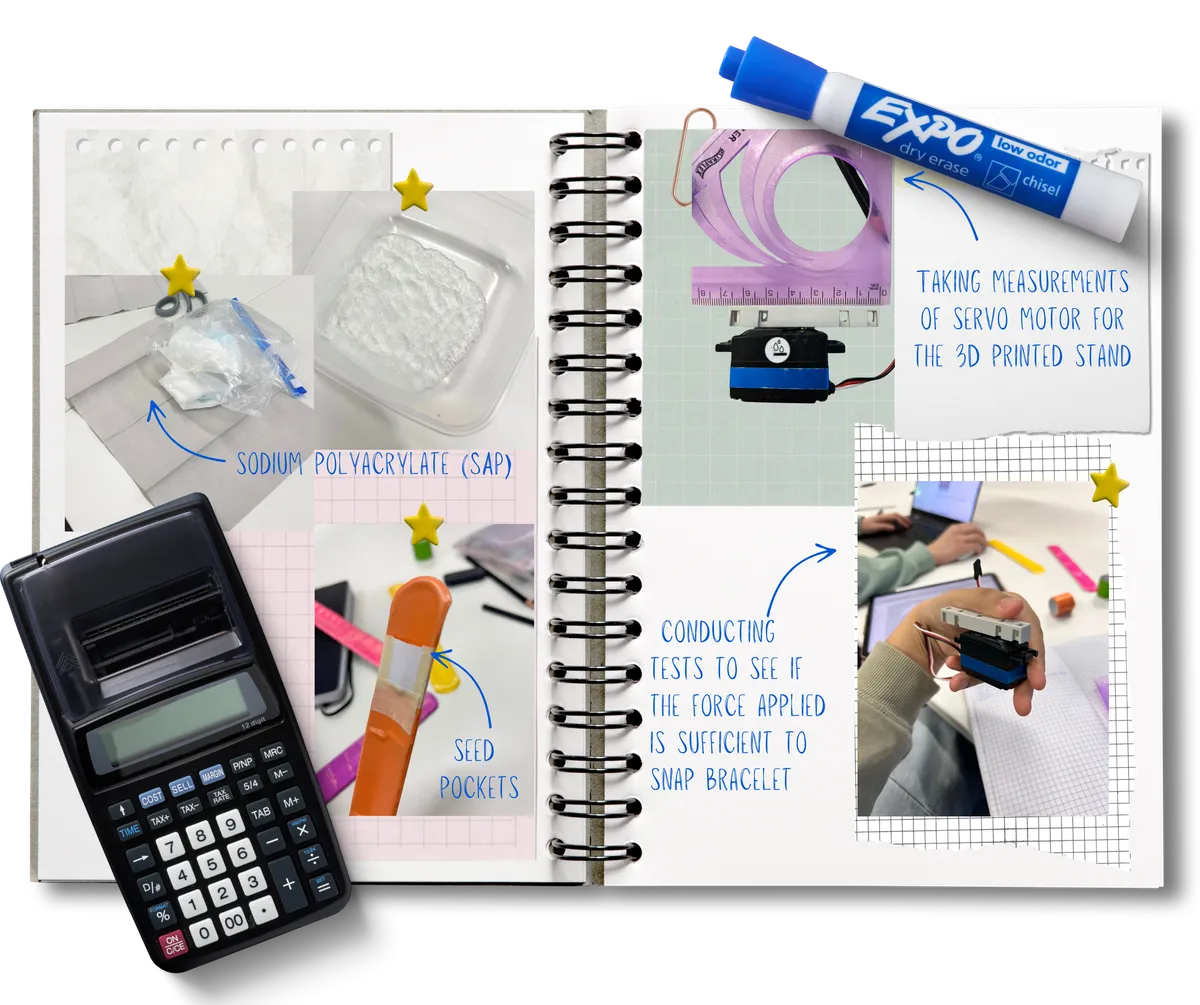
One of the best tools we were introduced to in this course was the logbook. Each student had to keep a physical diary to document ideas, research, progress, and discoveries. That’s when I knew I had found the right focus field. Nothing screams Carina more than keeping a diary. I loved every bit of it! I never forgot it at home, always updated it with notes, printed pictures, and even added stickers. Our professors encouraged us to avoid tablets and laptops, emphasizing the benefits of staying unplugged and focused. It honestly felt like being a real scientist.
The logbook kept me organized and gave me space to revisit old ideas, scrap ones that didn’t work, and build a clearer path forward. It also helped me avoid digital distractions (no "Good Pizza, Great Pizza" sessions on the iPad!). During those weeks, I ran a lot of tests, but I was torn between taking a more biological route or a technical one.
At one point, I considered using a hairdryer (as wind) to simulate a trigger, then thought of rainfall, which could be more realistically replicated. The core idea was to design something that could spread seeds in remote areas without needing intensive manual labour. I ultimately settled on rainfall as the trigger and that’s when things got really interesting.
Challenging myself to go the biologist route, I decided to experiment with sodium polyacrylate (SAP); the stuff that absorbs liquid and swells up, found in diapers. So off I went: I bought a pack, cut them open, and carefully extracted the granules by rubbing the material in a plastic bag to generate static. It was oddly satisfying. But the best part? Adding water and watching the granules swell and turn into a gel. They absorbed so much! Even my professor was amazed by their capacity.
Sadly, I had a personal emergency that cut my progress short, and I missed a few classes. When I returned, just two weeks before the deadline, it felt like I was in the final round of a baking competition: pure chaos, pressure, and everyone frantically testing their prototypes. The professor made it clear: no functioning device, no pass.
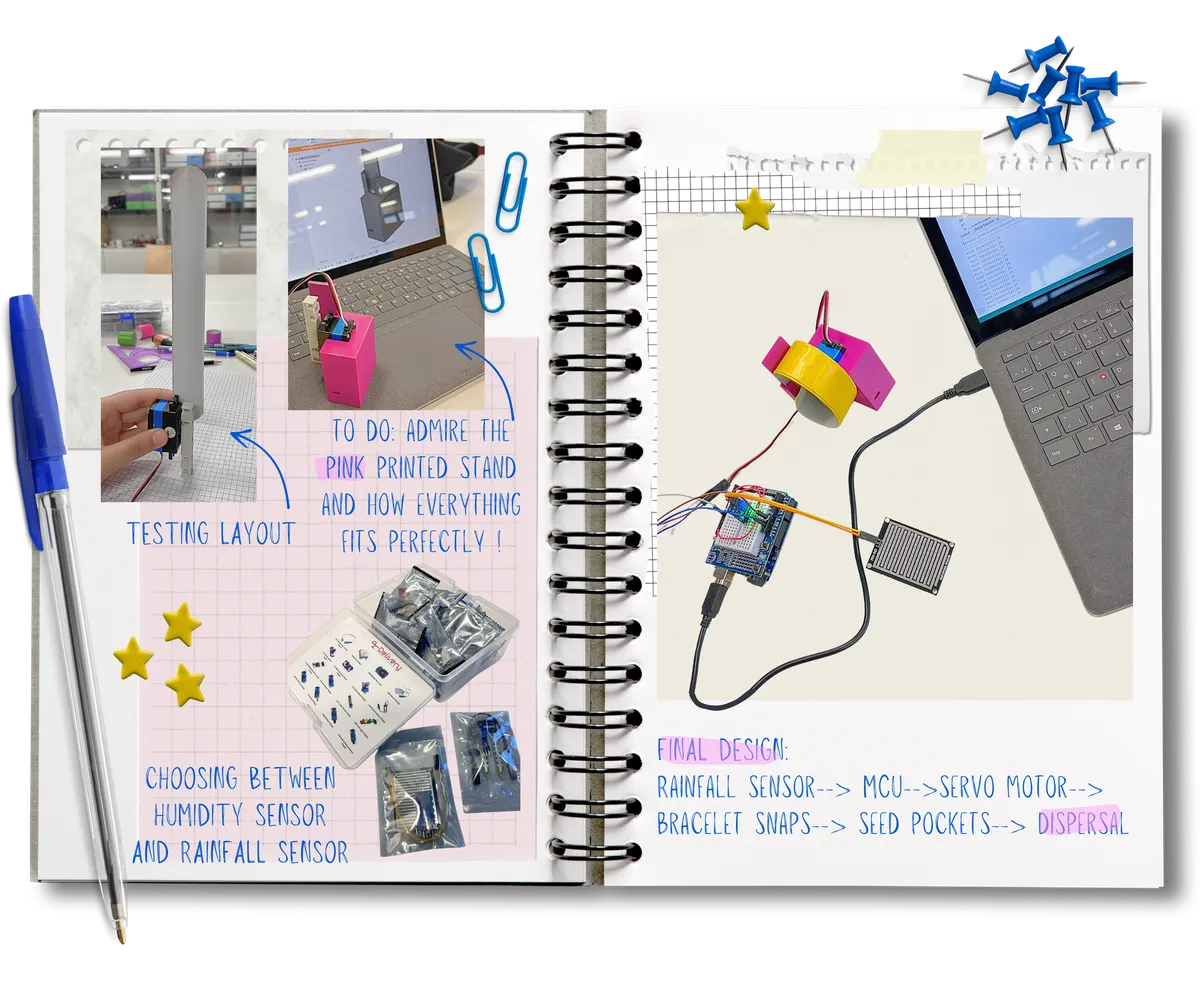
I was panicking, but then I thought, okay, I'll have to engineer this. Never thought the technical path would become my comfort zone, but it has. I grabbed an Arduino Uno, a rainfall sensor, and a servo motor, but now I needed to figure out what the motor would actually trigger.
That’s when I remembered a useful website my professor had mentioned in our first lecture: AskNature. I asked nature and nature delivered "What Puts the Explosive Pop in Popping Cress?". This article was a goldmine, since there isn’t much accessible research on popping cress, especially with all its variants. It introduced me to the concept of bistability; a system with two stable states. The perfect everyday example? A snap bracelet! (Yes, those metal ones inside silicone wristbands and kids’ toys.)
So I had a plan: use the servo motor to trigger the snap bracelet, which would launch seed packets made from simple paper. The rainfall sensor would detect moisture, the Arduino would receive the signal, and the motor would push the bracelet just enough to make it curl and snap; launching the seeds!
With only a week left, everything was coming together. But I needed a proper stand to hold the bracelet and motor. I considered using the classroom materials;cardboard, foam, paper, but building something sturdy would take too long. So naturally, I turned to CAD and 3D printing.
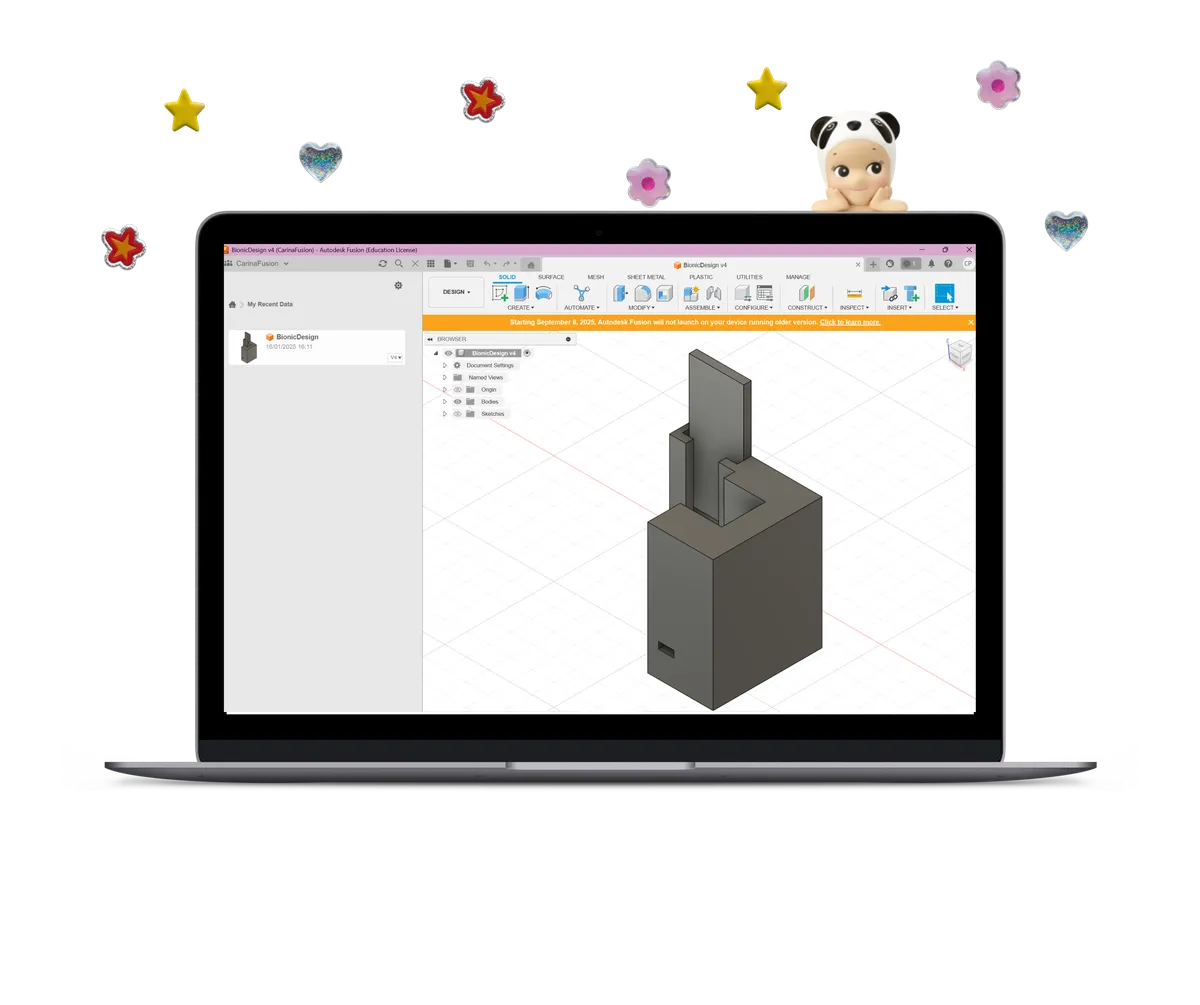
Although I had more experience with SolidWorks (from my Engineering Drawing & Design module), we had a lab on AutoCAD in our Bionics course. Since the professors leaned more toward AutoCAD, I chose AutoCAD (it's a nice interface). I designed a stand with slots for the motor and bracelet. Little tip: always make the slots slightly bigger to account for printing tolerances.
I sliced the model, generated the G-code, and submitted it for printing. Other students were also in the queue, so I picked it up the next day and ran a quick test. Everything worked! The sensor, the code, the snap and the seeds launched. It was such a satisfying moment.
This was my first fully hands-on individual project, and I got to apply nearly everything I’d learned: microcontrollers, coding, CAD, 3D printing, sensors, biomimetic science, research, and logbook keeping. If I had more time (and less deadline pressure), I would’ve loved to explore more biological approaches, maybe even make my own bistable material or find natural triggers. And how nice would it be to scale this up with a tube-based seed supply system?
Overall, this project was deeply inspiring. It pushed me to think both creatively and analytically, blending biology with engineering in a way that made me feel like both a designer and a scientist. I hope this post gave you some insight, and if you're curious, stick around for more!
Logging off for now,
Carina
Logging off for now,
Carina